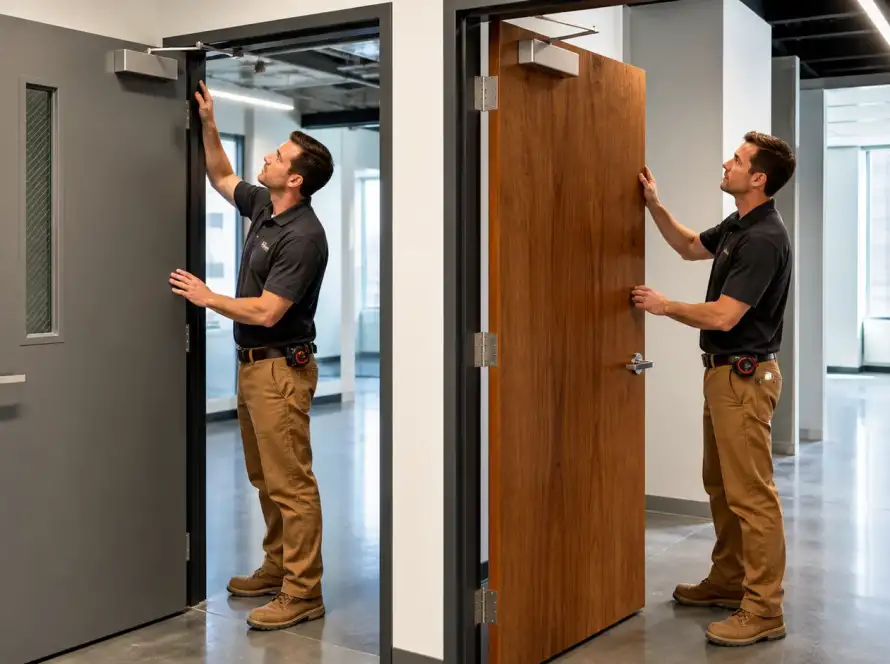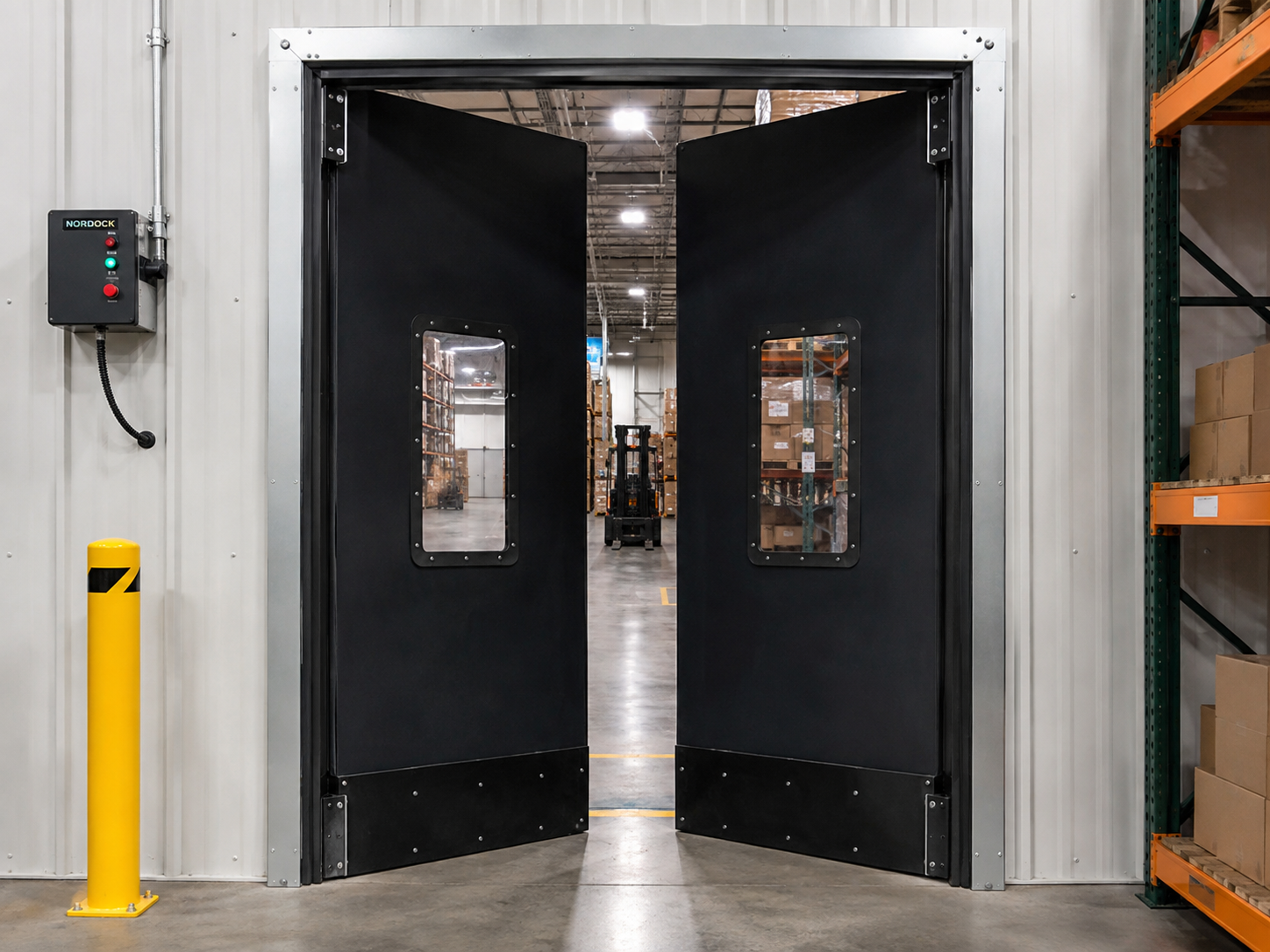
Traffic doors are commercial swinging or double-acting doors built for high-frequency openings where people, carts, and materials move between spaces. We commonly specify them for warehouses, manufacturing facilities, restaurants, commercial kitchens, grocery stores, retail stockrooms, distribution centres, food-processing facilities, and service corridors.
Unlike conventional commercial openings, traffic doors are generally selected for operational flow, impact exposure, visibility, cleanability, and repeated use. Security, controlled access, latching, electrified hardware, and fire-rated requirements may call for a different door and frame assembly.
What Are Traffic Doors And Which Types Fit The Opening?
Commercial traffic doors are designed to move with the operation. They often swing freely in one or both directions, allowing staff to pass through while carrying materials, pushing carts, or moving stock. Many swinging traffic doors return toward the closed position after use, helping separate adjacent work areas without slowing daily movement.
Single traffic doors suit narrower openings, controlled one-way movement, or lower-volume traffic. Double traffic doors provide more clear width for carts, rolling racks, dollies, and bidirectional traffic. Double-acting traffic doors swing in either direction and are commonly used in kitchens, stockrooms, warehouses, production areas, and service spaces.
Traffic Door TypeTypical ApplicationTraffic LevelKey Characteristics
Single Traffic DoorStockrooms, prep rooms, service corridorsLow to moderateNarrower opening, controlled movement
Double Traffic DoorWarehouses, receiving areas, larger kitchensModerate to highWider clear opening for carts and opposing traffic
Double-Acting Traffic DoorKitchens, production spaces, material handlingHighSwings both directions and returns toward closed
Impact Traffic DoorRetail back rooms, grocery, warehouse aislesHighProtection against repeated contact
Industrial Traffic DoorFactories, distribution centres, heavy-use areasHigh to demandingDurable panels, protection, and wider configurations
Impact traffic doors and commercial impact doors are appropriate where carts, racks, equipment, or frequent personnel movement repeatedly contact the panel. Heavy-duty traffic doors are not automatically the right choice for every opening. We recommend matching the panel construction and protection features to the actual traffic crossing the opening.
Traffic Door Materials, Vision Panels and Protection Features
Material selection should reflect impact exposure, sanitation needs, moisture, temperature conditions, cleanability, appearance, and expected maintenance. No single material is suitable for every project, so we review the operating environment before coordinating commercial traffic doors.
ABS traffic doors are commonly selected where durable, impact-resistant, and cleanable panels are needed in commercial or industrial settings. HPL traffic doors can suit institutional, retail, and service environments where surface appearance and durability both matter. Stainless steel surfaces, kick plates, protective plates, and edge protection are often considered in commercial kitchens, food processing, washdown-adjacent spaces, and industrial operations.
Material Or ComponentDurabilityAppearanceCleanabilityTypical Applications
ABSGood impact resistancePractical commercial finishEasy to cleanStockrooms, warehouses, production areas
HPLDurable finished surfaceBroad finish optionsSuitable for regular cleaningRetail, institutional, service corridors
Stainless Steel ProtectionSuitable for wear areasIndustrial and food-service appearanceSuitable for cleanable environmentsKitchens, food service, processing areas
Aluminum ComponentsApplication dependentClean architectural appearanceApplication dependentSelected trims, protection, and components
Insulated ConstructionEnvironment dependentFunctional finishCoordinate with conditionsCoolers, cold rooms, refrigerated storage
Insulated traffic doors may be considered for cooler rooms, cold storage, refrigerated areas, and temperature-controlled production. We recommend confirming manufacturer-specific performance data and coordinating the door with the wall assembly, moisture conditions, and temperature separation requirements.
Vision panels improve line of sight around opposing staff, carts, and equipment. Rectangular windows, round windows, and multiple-panel configurations can be considered based on traffic patterns and the required viewing area. Protection features may include kick plates, bumpers, reinforced panels, wear protection, stainless steel plates, and edge protection.
Industrial Traffic Doors for Warehouses and Cold Storage
Industrial traffic doors should be selected according to the traffic passing through the opening, not simply by choosing the heaviest available panel. In warehouses, factories, manufacturing plants, distribution centres, service corridors, and material-handling spaces, the opening may see personnel, stock carts, dollies, rolling racks, wheeled equipment, and repeated panel contact.
Warehouse traffic doors often require careful review of opening width, clear passage needs, door configuration, and vision requirements. A single door may work for staff-only movement, while double industrial swinging doors may better support carts or bidirectional traffic. Where repeated contact from racks, carts, or equipment is expected, industrial impact doors or heavy-duty traffic doors may be appropriate.
For industrial openings, we typically consider:
- Actual personnel, cart, rolling rack, and equipment traffic
- Panel material, reinforcement, edge protection, and bumper requirements
- Vision-panel configuration for opposing traffic and operational visibility
- Opening width, wall condition, and available clearance around the opening
- Maintenance access and the expected frequency of operation
Cold storage traffic doors and cooler traffic doors need additional coordination. Insulation, frequent operation, moisture, sanitation, durability, and surrounding wall conditions all affect selection. In food-processing and refrigerated-storage areas, the panel and protection details should fit the actual environment rather than relying on a general-purpose traffic-door specification.
Restaurant, Retail and Institutional Traffic Door Applications
Restaurant traffic doors help separate dining areas from kitchens, prep rooms, storage spaces, dishwashing areas, and service corridors while allowing staff to move efficiently. Double-acting kitchen doors are often useful where staff carry trays, food supplies, or equipment through the opening. Cleanable surfaces, stainless steel protection, kick plates, bumpers, and vision panels may be considered based on the operation.
Retail traffic doors support stockrooms, receiving areas, employee-only spaces, grocery stores, supermarkets, and merchandising support rooms. Retail impact doors and stockroom traffic doors should account for merchandise dollies, stock carts, rolling racks, and receiving traffic, not only pedestrian movement.
Healthcare support areas, schools, municipal buildings, public works facilities, and other institutional spaces may have specific requirements affecting finish, visibility, hygiene, panel material, and impact protection. Where controlled access, latching, fire separation, or electrified hardware is required, conventional hollow metal doors, commercial wood doors, or aluminum doors may be more appropriate than traffic doors.
Common application considerations include:
- Restaurants and commercial kitchens, where staff movement and cleanability matter
- Grocery and retail stockrooms, where carts and merchandise handling affect panel protection
- Warehouses and distribution centres, where opening width and equipment traffic drive selection
- Food-processing and cold-storage spaces, where sanitation, moisture, and temperature conditions apply
- Institutional support areas, where finish, visibility, and project specifications must be coordinated
Selecting and Coordinating Commercial Traffic Doors
A traffic door should fit the opening, the work flow, and the environment. We encourage contractors, facility managers, architects, and procurement teams to confirm conditions before release, particularly during late-summer and fall construction cycles when coordinated procurement and lead-time planning can affect project schedules.
Traffic doors differ from standard commercial doors because they prioritize frequent movement and impact tolerance. Standard doors are generally more appropriate where security, conventional latch hardware, controlled access, fire-rated opening requirements, or electrified hardware coordination govern the opening.
FeatureTraffic DoorStandard Commercial Door
Typical OperationFrequent swinging movementControlled opening and closing
Traffic FrequencyHigh-cycle personnel and cart useTypical room-entry traffic
Double-Acting CapabilityOften availableLess common
Impact ExposureOften anticipatedUsually limited
SecurityGenerally secondaryOften a primary concern
Common ApplicationsKitchens, stockrooms, warehousesOffices, secured rooms, rated openings
HardwareTraffic-door hardware and protectionLatch, lock, closer, and access hardware
Common selection mistakes include underestimating cart impact, ordering from unconfirmed opening dimensions, selecting vision panels that do not suit traffic patterns, choosing unsuitable materials for washdown or food-service areas, overlooking temperature-control needs, and prioritizing initial price over application suitability.
Before ordering, confirm opening width and height, wall or opening condition, single or double configuration, traffic direction, personnel and cart use, equipment exposure, panel material, finish, vision panels, protection features, environmental conditions, cold-storage requirements, quantities, and installation conditions. Accurate field information supports coordinated submittals, shop drawings, procurement, and installation planning for Ontario projects.
Coordinate Traffic Door Packages With Confidence
Ontario Commercial Doors supports Division 8 procurement with product guidance tailored to operating conditions, opening requirements and project schedules. Industrial traffic doors can be coordinated with frames, hardware and protective accessories to support a complete opening package. Our team works with contractors, consultants and procurement teams to align product selections with specifications, submittals and lead-time requirements.
FAQs
What Is A Traffic Door?
A traffic door is a commercial swinging door designed for frequent movement between spaces. It commonly supports personnel, carts, stock, and materials moving through warehouses, kitchens, stockrooms, production areas, and service corridors. Many models are configured for double-acting operation and include vision panels or impact protection.
What Is An Impact Traffic Door?
An impact traffic door is designed for openings where repeated contact from people, carts, racks, dollies, or equipment is expected. Depending on the application, it may include reinforced panels, bumpers, protective plates, edge protection, or other wear-resistant features suited to high-cycle commercial and industrial use.
What Are Traffic Doors Made From?
Traffic doors may use ABS, HPL, stainless steel surfaces or protection, aluminum components, insulated construction, and other application-specific materials. The right choice depends on impact exposure, cleanability, moisture, appearance, temperature conditions, sanitation requirements, and the type of traffic using the opening.
What Is A Double-Acting Traffic Door?
A double-acting traffic door swings in either direction and returns toward the closed position after passage. This operation is useful where staff move frequently through an opening while carrying materials or pushing carts. Kitchens, warehouses, stockrooms, and production areas commonly use double-acting traffic doors.
Where Are Traffic Doors Commonly Used?
Traffic doors are commonly used in warehouses, distribution centres, factories, manufacturing facilities, restaurants, commercial kitchens, grocery stores, retail stockrooms, food-processing plants, service corridors, and institutional support areas. The door configuration and protection level should match the traffic and environmental conditions.
What Type Of Traffic Door Is Used In A Commercial Kitchen?
Commercial kitchens often use double-acting restaurant traffic doors with cleanable surfaces, vision panels, and protection such as kick plates or stainless steel panels. The selected door should account for staff movement, dish carts, food-service traffic, sanitation practices, and the connection between kitchen and dining or service areas.
What Traffic Doors Are Suitable For Warehouses?
Warehouse traffic doors should suit the actual movement through the opening, including staff, carts, dollies, rolling racks, and wheeled equipment. Double-door configurations, vision panels, reinforced panels, bumpers, and edge protection may be appropriate where traffic volume or repeated panel contact is expected.
Can Traffic Doors Have Windows Or Vision Panels?
Yes, traffic doors can include vision panels to improve line of sight around opposing personnel, carts, and equipment. Common options include rectangular windows, round windows, and multiple-panel layouts. The configuration should reflect the opening height, traffic patterns, and visibility needs of the space.
What Is The Difference Between A Traffic Door And A Regular Commercial Door?
Traffic doors are intended for frequent movement, swinging operation, and possible impact from carts or equipment. Regular commercial doors are more often selected for security, latching, controlled access, fire-rated assemblies, or electrified hardware. The correct choice depends on the opening’s operational and specification requirements.
Are Traffic Doors Suitable For Industrial Facilities?
Yes, industrial traffic doors can be suitable for factories, warehouses, manufacturing plants, production areas, and material-handling spaces. Heavy-duty traffic doors or industrial impact doors may be appropriate where repeated contact, high traffic frequency, wider openings, and equipment movement create greater demands on the door panels.
How Do I Choose The Correct Traffic Door?
Choose a traffic door by reviewing opening size, traffic direction, personnel movement, cart and equipment use, frequency of operation, impact exposure, environmental conditions, sanitation requirements, temperature separation, material, vision needs, finish, protection features, and installation conditions. Field-verified opening details should guide final selection.
What Information Is Required To Order A Traffic Door?
Ordering information should include opening width and height, wall condition, single or double configuration, traffic type, traffic frequency, personnel and cart use, equipment exposure, material, finish, vision panels, impact protection, environmental conditions, cold-storage needs, quantities, and installation requirements. Confirming these details early helps avoid unsuitable door selections and procurement delays.